

The Master Guide to Essential Firearm Accessories: Upgrading for Precision, Safety, and Performance
Essential Firearm Accessories, A factory-standard firearm is a capable tool, but in the modern era of shooting sports and personal defense, it is merely a blank canvas. Today’s shooters demand modularity. Whether you are building a competitive 3-Gun rifle, optimizing an Everyday Carry (EDC) handgun, or securing a home-defense shotgun, integrating the right firearm accessories is critical to maximizing your platform’s potential.
However, accessorizing is not about bolting on every available piece of aftermarket gear. It is about purpose-driven modification. Every accessory added must serve a distinct purpose: improving target acquisition, enhancing ergonomics, ensuring positive identification, or guaranteeing absolute safety.
This comprehensive guide breaks down the essential firearm accessories of 2026, the science behind how they work, and how to select the right gear for your specific discipline.
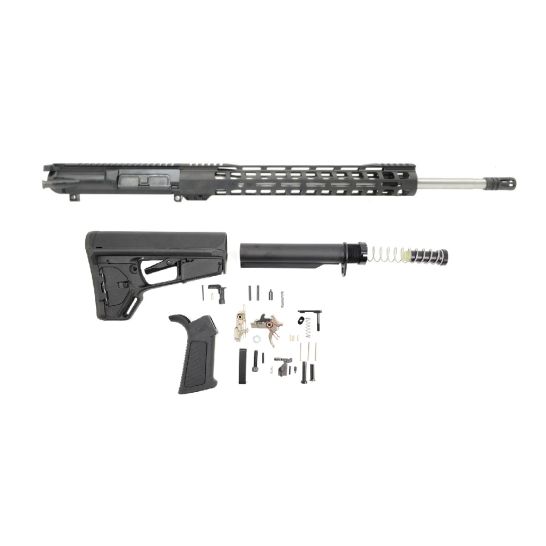
Optics and Sights: Redefining Accuracy and Target Acquisition
The days of relying solely on standard iron sights are fading. Modern optical technology allows shooters to keep both eyes open, maintaining crucial situational awareness while achieving rapid target acquisition.
Red Dot Sights (RDS) and Holographic Optics
For handguns and close-quarters carbines, miniature red dot sights (RDS) are the industry standard. These optics project an illuminated reticle (usually measured in MOA, or Minute of Angle) onto a glass lens.
- Pistol Optics: A 3 MOA to 6 MOA dot is ideal for handguns, balancing precision with the speed needed to locate the dot under recoil. Modern pistol red dots feature “shake-awake” technology, ensuring the optic is on the moment you draw.
- Holographic Sights: Unlike traditional red dots that use an LED emitter, holographic sights use lasers to project a hologram. They are highly favored for rifles because the reticle size does not distort when viewed through a secondary magnifier.
Low Power Variable Optics (LPVO)
The LPVO has revolutionized the rifle accessory market. Operating typically on a 1-6x, 1-8x, or even 1-10x magnification scale, an LPVO offers the true 1x magnification of a red dot for close-range engagements, while allowing the shooter to dial up the magnification for precise shots at 300 to 500 yards. When selecting an LPVO, pay close attention to the focal plane (First Focal Plane vs. Second Focal Plane) and the quality of the glass clarity.
Co-Witnessing Iron Sights
Even with advanced optics, electronics can fail. Suppressor-height iron sights are an essential accessory for any optics-equipped handgun or rifle. Co-witnessing allows your iron sights to align with the optical window, providing a fail-safe backup system.

Illumination: Tactical Weapon Lights and Positive Identification
A foundational rule of firearm safety is: “Be sure of your target and what is beyond it.” You cannot verify a target in the dark. Therefore, a high-quality tactical weapon light is an indispensable accessory for any defensive firearm.
Lumens vs. Candela: Understanding Light Metrics
When shopping for weapon-mounted lights (WML), consumers often look exclusively at “Lumens,” but this is only half the equation.
- Lumens (Spill): This measures the total amount of visible light emitted. High lumens create a wide “spill” that illuminates an entire room, which is excellent for close-quarters home defense.
- Candela (Throw): This measures the peak intensity of the light beam. High candela means the light can punch through the darkness (and photonic barriers like streetlights or fog) over long distances. For outdoor rifle applications, high candela is mandatory.
Pro Tip: Ensure your weapon light features ambidextrous switching so you can activate the illumination momentarily without breaking your firing grip.
Holsters and Retention Systems: Carrying with Confidence
For handgun owners, the holster is arguably the most critical accessory you will purchase. A high-quality holster does three things: it retains the firearm securely, it completely covers and protects the trigger guard, and it keeps the weapon oriented safely.
IWB vs. OWB Holsters
- Inside the Waistband (IWB): The gold standard for concealed carry. Often worn at the 3 o’clock position or Appendix (AIWB). Modern IWB holsters feature “claws” or “wings” that push against the belt, rotating the firearm’s grip inward to prevent printing through clothing.
- Outside the Waistband (OWB): Preferred for duty use, range training, and competitive shooting. OWB holsters offer faster draw times and are generally more comfortable but require an overgarment for concealment.
Material: Kydex vs. Leather
While leather holsters offer classic aesthetics and comfort, Kydex (a rigid, molded thermoplastic) dominates the 2026 market. Kydex is custom-molded to the exact exact specifications of your firearm, providing an audible “click” when the weapon is securely seated. Unlike leather, Kydex will never soften or fold into the trigger guard over time.
Understanding Retention Levels
- Level I: Relies entirely on passive friction. Excellent for concealed carry.
- Level II: Adds an active retention mechanism (like a thumb-release hood) that must be deactivated to draw. Essential for open carry to prevent unauthorized disarming.
Essential Firearm Accessories: Ergonomics and Recoil Management
A firearm must fit the shooter. Upgrading your platform’s ergonomics translates directly to better recoil mitigation and faster follow-up shots.
M-LOK Rail Accessories and Foregrips
The M-LOK (Modular Lock) system has universally replaced the heavier Picatinny quad-rails on modern rifles. This system allows shooters to attach accessories directly to the handguard only where needed, saving weight.
- Angled Foregrips (AFG) & Hand Stops: These accessories allow the shooter to pull the rifle tightly into the shoulder pocket, utilizing the “C-Clamp” grip method to drive the muzzle from target to target while mitigating vertical muzzle climb.
The Two-Point Rifle Sling
A common adage in the firearms community is: “A sling is to a rifle what a holster is to a handgun.” A modern, quick-adjust two-point sling allows you to retain the rifle hands-free to transition to a secondary weapon, administer medical aid, or climb obstacles. Single-point slings are largely obsolete for general use, as they offer no retention when the user is moving.
Maintenance & Safe Storage: The Unsung Heroes of Reliability
The most expensive optics and triggers are useless if the firearm experiences a mechanical malfunction due to neglect, or worse, falls into the wrong hands.
Firearm Cleaning Kits
Carbon buildup and copper fouling will degrade accuracy and reliability. Every shooter needs a comprehensive cleaning kit featuring:
- CLP (Cleans, Lubricates, Protects): The all-in-one solvent for modern firearms.
- Bore Snakes: A fast, efficient way to clear the barrel of fouling without pushing a rigid cleaning rod from the muzzle end (which can damage the barrel crown).
Biometric Gun Safes: Essential Firearm Accessories
Responsible storage is the cornerstone of firearm ownership. For quick access, biometric gun safes represent the pinnacle of 2026 technology. These safes use advanced fingerprint scanners or RFID technology to open in fractions of a second, ensuring you have immediate access during an emergency while keeping the firearm completely inaccessible to children or unauthorized users.
Legal & Safety Considerations for Modifying Firearms
Disclaimer: Firearm compliance varies heavily by jurisdiction.
Before adding any accessory—such as a vertical foregrip to a pistol, or a suppressor to a rifle—you must deeply understand the National Firearms Act (NFA) and your local state laws. Ignorance of the law is not a defense. Furthermore, any modifications to internal components (like dropping in a match-grade trigger) should ideally be performed by a certified gunsmith to ensure the internal drop-safeties remain fully functional.
Essential Firearm Accessories
Q: Do I need a red dot sight on my concealed carry handgun?
A: While not strictly mandatory, a red dot sight drastically improves target acquisition speed and accuracy, especially in high-stress situations or low-light environments. It allows you to remain “target-focused” rather than shifting your vision back to the front sight post.
Q: What is the difference between M-LOK and KeyMod?
A: M-LOK and KeyMod are both modular rail systems for attaching accessories to a rifle’s handguard. However, extensive military testing has proven that M-LOK provides superior retention for heavy accessories under extreme stress and dropping. As of 2026, M-LOK is the undisputed industry standard.
Q: Can I use WD-40 to clean my firearm?
A: No. Standard WD-40 is a water displacer, not a dedicated firearm lubricant. It can leave a sticky residue that attracts dust and carbon, leading to malfunctions. Always use a dedicated firearm CLP (Cleaner, Lubricant, Preservative).
Essential Firearm Accessories
., ., ., ., ., ., ., ., ., ., ., ., ., ., ., ., ., ., ., ., ., ., ., ., ., ., ., ., .,.,